Artificial Intelligence is changing the way the world operates, and behind every intelligent application is an infrastructure that demands enormous computing power. As AI data centers expand to accommodate GPU-intensive workloads, their energy requirements are growing at an unprecedented pace. Managing this demand while ensuring uninterrupted operations and long-term sustainability has become a major challenge for the industry. This is where Battery Energy Storage Systems (BESS) are making a difference. More than just a backup power solution, BESS is transforming how data centers store, manage, and distribute energy, creating new opportunities for architects and MEP engineers to rethink infrastructure design.
1. Beyond Backup Power: How BESS Is Transforming Energy Management
Traditional backup systems are primarily designed to maintain operations during power outages. However, modern AI data centers require a more flexible approach to energy management. BESS introduces this flexibility by storing electricity when it is available and releasing it when demand increases.
By integrating battery storage with the facility’s electrical infrastructure, data centers can improve power management and respond more effectively to changing energy requirements.
Key energy benefits of BESS include:
Peak Shaving: Supplies stored electricity during periods of high demand, helping reduce peak grid consumption and potentially lowering demand-related electricity costs.
Load Balancing: Helps manage fluctuations in power demand caused by intensive AI computing workloads.
Renewable Energy Integration: Stores excess solar and other renewable energy for use when generation is limited.
Grid Resilience: Provides rapid-response power support during grid disturbances and complements UPS systems and backup generators.
Energy Optimization: Enables intelligent charging and discharging based on electricity tariffs, grid conditions, and facility demand.
BESS does not directly reduce the electricity consumed by AI servers. Instead, it changes how electricity is sourced, stored, and distributed, helping facilities make better use of available energy.
2. The Architect’s Perspective: Designing Space for Energy Storage
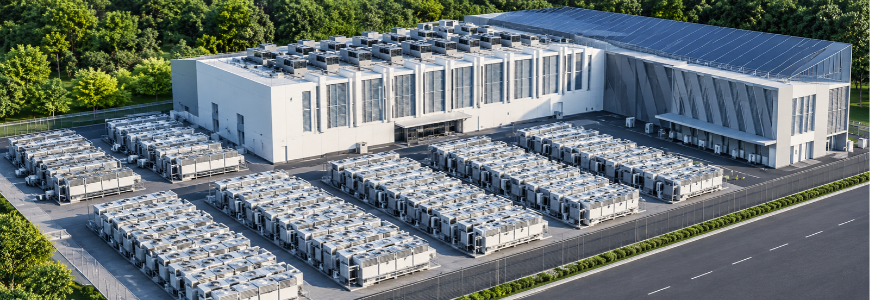
When planning an AI data center, architects must look beyond server halls and cooling infrastructure. Energy storage is becoming an important part of the overall site layout, influencing spatial planning, building organization, accessibility, and safety.
BESS installations require carefully selected locations that allow seamless integration with electrical infrastructure while maintaining safe distances from other building functions.
Architectural considerations include:
Strategic Site Planning: Identifying suitable locations for battery installations in relation to substations, transformers, generator yards, and electrical rooms.
Space and Zoning: Allocating dedicated areas for battery enclosures, maintenance access, equipment replacement, and future expansion.
Structural Coordination: Addressing foundation design, equipment weight, and structural loading requirements.
Fire and Life Safety: Coordinating equipment separation, fire-rated construction where required, emergency access, and applicable safety codes.
Environmental Planning: Considering weather protection, flood risks, acoustic impact, ventilation, and surrounding site conditions.
The architectural challenge is to make energy storage a seamless part of the data center environment while ensuring that safety, functionality, and future scalability remain central to the design.
3. The MEP Perspective: Engineering Reliability, Cooling, and Performance
While architects establish the spatial framework, MEP engineers bring the BESS infrastructure to life. Their role is essential in ensuring that battery storage operates efficiently, safely, and in coordination with the data center’s critical systems.
BESS integration requires a multidisciplinary engineering approach covering electrical distribution, mechanical cooling, fire protection, plumbing, and intelligent monitoring.
Key MEP engineering responsibilities include:
Electrical Engineering: Determining battery power capacity (MW) and energy capacity (MWh), designing electrical connections, and coordinating integration with UPS systems, generators, transformers, and switchgear.
Mechanical Engineering: Designing cooling and ventilation systems to maintain appropriate battery operating temperatures and manage heat rejection.
Fire Protection Engineering: Coordinating fire detection, suppression, emergency isolation, and thermal runaway mitigation strategies.
Plumbing and Drainage: Planning drainage systems and evaluating containment requirements for potential firefighting water runoff.
Controls and Monitoring: Integrating Battery Management Systems (BMS) and Energy Management Systems (EMS) for real-time monitoring, battery health assessment, and intelligent energy control.
The success of BESS depends on how effectively these systems work together. Even the most advanced battery technology requires well-coordinated engineering to deliver reliable performance.
4. Building Future-Ready AI Data Centers Through Integrated Design
As AI computing continues to evolve, data centers must be designed to accommodate increasing power densities, changing operational demands, and greater expectations for energy efficiency. BESS offers an opportunity to make these facilities more adaptable and resilient.
However, successful implementation requires a forward-thinking design approach that considers:
Battery chemistry, lifecycle performance, and operational requirements.
Appropriate storage capacity and backup duration.
Thermal management, fire safety, and emergency response.
Integration with renewable energy and on-site power generation.
Modular infrastructure and provisions for future expansion.
Coordination between architectural, electrical, mechanical, and fire protection systems.
The real opportunity lies in treating BESS as part of an integrated building and energy strategy rather than an isolated electrical installation. This collaboration allows design teams to create infrastructure that responds to today’s computing demands while remaining adaptable to tomorrow’s technologies.
Ultimately, the future of AI data centers will depend not only on computing innovation but also on how intelligently their energy infrastructure is designed. Battery Energy Storage Systems are becoming a vital part of this transition, connecting power reliability, energy management, and sustainable development. At Daymark, the integration of architectural thinking and multidisciplinary engineering is fundamental to creating high-performance, future-ready data center environments.
Frequently Asked Questions (FAQs)
BESS is a system that stores electrical energy and supplies it when required. In AI data centers, it supports peak demand management, power reliability, renewable energy integration, and improved energy flexibility.
BESS optimizes electricity usage through peak shaving, load balancing, and energy shifting. It can also store excess renewable energy for later use, helping reduce dependence on grid electricity during peak periods.
Architects are responsible for site planning, space allocation, equipment zoning, structural coordination, maintenance access, and incorporating fire and life safety requirements into the overall building design.
MEP engineers evaluate battery capacity, electrical distribution, UPS and generator integration, cooling and ventilation, fire protection, drainage, monitoring systems, and energy management controls.
Not necessarily. BESS can complement UPS systems and backup generators. Replacing these systems requires detailed evaluation of critical loads, backup duration, redundancy, electrical configuration, and operational requirements.
BESS supports renewable energy integration, peak demand management, and flexible electricity consumption. When paired with renewable energy sources, it can help reduce reliance on carbon-intensive grid electricity.