
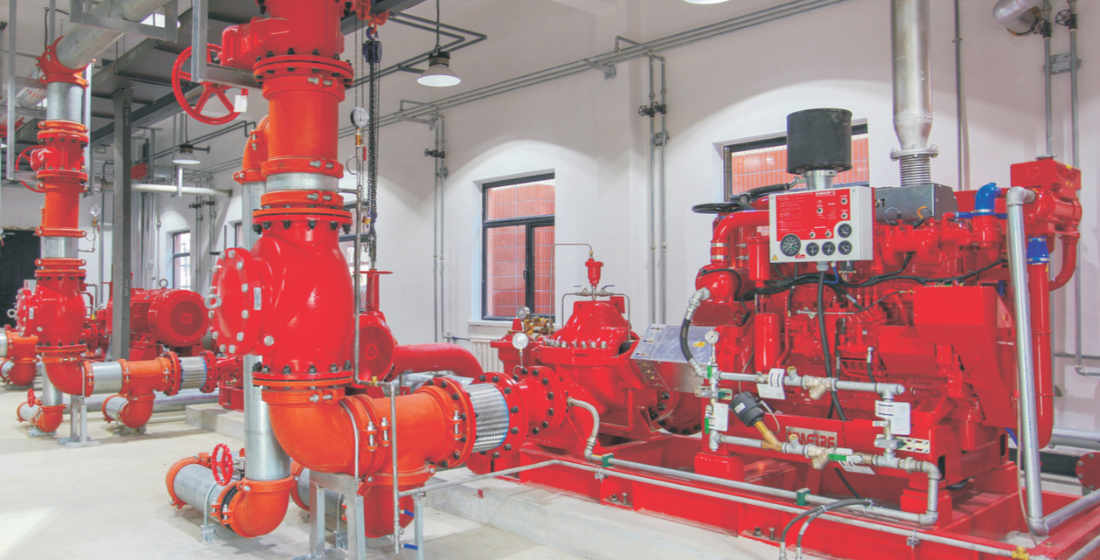
When Can a Fire Pump Be Removed? A Guide to Fire Pump Decommissioning
Fire pumps are an important component of many building fire protection systems. They are used when the available water supply cannot provide the pressure and flow required by the fire protection system.
As buildings change, however, the conditions that originally required a fire pump can also change. A municipal water supply may be upgraded, a building may undergo a major renovation, the occupancy may change, or the fire protection system may be redesigned.
This can lead building owners and project teams to ask:
Can the fire pump be removed?
In some circumstances, the answer may be yes. But a fire pump should never be removed simply because it appears unnecessary, expensive to maintain, or oversized compared with current building conditions.
The decision requires a documented engineering evaluation of the water supply, fire protection demand, building characteristics, applicable codes and standards, and approval requirements.
The objective is not simply to eliminate equipment. It is to demonstrate that the building’s fire protection system can continue to provide the required level of protection without the pump.
What Does a Fire Pump Do?
A fire pump is used to provide the pressure and flow needed by a fire protection system when the available water supply cannot meet the system demand on its own.
Fire pumps can support systems such as:
- Automatic sprinkler systems
- Standpipe systems
- Combined sprinkler and standpipe systems
- Other water-based fire protection systems
The need for a pump depends on the relationship between the available water supply and the hydraulic demand of the fire protection system.
NFPA 20 provides requirements for stationary pumps used for fire protection, while applicable building and fire codes establish requirements for fire protection water supplies and related systems.
This means the presence of a fire pump should be evaluated as part of the complete fire protection system, not as an isolated piece of equipment.
When Can a Fire Pump Potentially Be Removed?
A fire pump may be a candidate for removal when a documented engineering evaluation demonstrates that it is no longer necessary to meet the required fire protection demand.
Potential circumstances can include:
- An improved water supply
- A major building renovation
- A change in occupancy or building use
- A redesigned fire protection system
- Changes in building configuration
- Changes in fire protection demand
- A previously conservative or outdated design
- Changes to applicable project requirements
However, none of these conditions automatically justifies removing the pump.
The critical question is:
Can the fire protection system meet its required flow and pressure without the pump under the applicable design conditions?
That question needs to be answered through engineering analysis and the appropriate approval process.
1. Verify That the Available Water Supply Is Adequate
The first consideration is the building’s available water supply.
A fire pump may originally have been installed because the municipal or private water supply could not provide enough pressure or flow for the fire protection system.
If that water supply has changed since the original design, the system may need to be reevaluated.
Possible changes could include:
- Municipal water-system improvements
- Changes in water-main configuration
- Increased available pressure
- Increased available flow
- A new water connection
- Changes to a private water supply
- Changes to the site’s fire protection infrastructure
However, simply observing higher static water pressure is not enough.
The fire protection system needs to be evaluated against the required flow and residual pressure under the applicable design conditions.
The International Fire Code, for example, establishes fire-flow requirements and states that for buildings with approved automatic sprinkler systems, the water supply must be capable of providing the greater applicable demand between the sprinkler system demand and required fire flow.
Why Hydraulic Testing Matters
A qualified fire protection engineer can evaluate the available water supply through appropriate testing and hydraulic analysis.
The assessment can consider:
- Static pressure
- Residual pressure
- Available flow
- Elevation
- Pipe friction losses
- System demand
- Hose-stream allowance where applicable
- Sprinkler demand
- Standpipe demand
- Water-supply reliability
The objective is to determine whether the water supply can meet the required system demand without relying on the fire pump.
If it cannot, removing the pump may compromise the fire protection system.
2. Recalculate the Fire Protection System Demand
A building’s current fire protection demand may differ from the conditions that existed when the original pump was installed.
An engineering review should therefore consider the current system rather than relying solely on historical documentation.
Depending on the system, this may involve reviewing:
- Sprinkler layouts
- Hazard classification
- Hydraulic design criteria
- Standpipe requirements
- Hose-stream allowances
- Piping configuration
- Building height
- Occupancy
- Water supply
- Fire protection zones
The goal is to determine the actual hydraulic demand that the water supply needs to satisfy.
This is important because a change in one part of the building can affect the fire protection requirements elsewhere.
3. Review the Building’s Current Occupancy and Use
A building’s fire protection requirements can change when its occupancy or use changes.
For example, converting a building from one use to another can affect:
- Hazard classification
- Occupant characteristics
- Storage arrangements
- Sprinkler design
- Standpipe requirements
- Fire-flow requirements
- Required water supply
A fire pump that appears unnecessary based on the physical building alone may still be required because of the building’s current occupancy or fire protection classification.
The current use should therefore be verified before making any decision about pump removal.
4. Evaluate Changes to the Building During Renovation
Major renovations provide an opportunity to reassess an existing fire protection system.
A project may involve changes to:
- Floor layouts
- Occupancy
- Building height
- Fire compartments
- Sprinkler coverage
- Standpipe systems
- Water supply
- Fire-rated assemblies
- Mechanical systems
If the fire protection system is being substantially redesigned, the engineering team can evaluate whether the existing pump is still required.
However, a renovation should not be treated as an automatic reason to remove the pump.
The revised system must still satisfy the applicable requirements.
5. Review the Applicable Codes and Standards
Fire pump removal is a code-sensitive decision.
The engineering team needs to identify the requirements applicable to the specific project, including the adopted editions and local amendments.
Potential references may include:
- NFPA standards
- International Building Code
- International Fire Code
- Local fire code
- Local building code
- Authority Having Jurisdiction requirements
- Insurance requirements
- Project-specific requirements
NFPA 20 is specifically concerned with the installation of stationary fire pumps, while building and fire codes address broader fire protection and water-supply requirements.
Because code adoption varies by jurisdiction, the applicable requirements need to be verified for the specific project.
6. Determine Whether the Fire Protection System Can Function Without the Pump
This is the central engineering question.
Removing a fire pump should only be considered when the redesigned or existing fire protection system can meet the required demand without it.
The evaluation can include:
Sprinkler System
Can the sprinkler system achieve its required hydraulic demand using the available water supply?
Standpipe System
If standpipes are present, can the required pressure and flow be achieved at the relevant hose connections?
Combined Systems
If sprinklers and standpipes share a water supply, can the combined demand be met?
Water Supply
Is the available water supply sufficiently reliable under the required design conditions?
Elevation
Does building height create pressure requirements that the water supply cannot overcome without pumping?
These questions need to be evaluated together.
For taller buildings, elevation and pressure requirements can become particularly important. NFPA materials recognize situations where fire department pumping capability may not be sufficient for upper portions of tall buildings, requiring additional fire protection measures.
7. Do Not Assume New Fire Suppression Technology Eliminates the Need for a Pump
The original Daymark article suggests that advanced systems such as pre-action, foam, dry-pipe, or clean-agent systems may allow a fire pump to be removed.
That statement needs to be significantly qualified.
Different fire suppression technologies are designed for different hazards and applications.
For example:
- Dry-pipe systems are still water-based sprinkler systems.
- Pre-action systems still involve water supply requirements.
- Foam systems have their own design requirements.
- Clean-agent systems are not simply interchangeable with water-based sprinkler protection.
- Water-mist systems have specific hydraulic and system requirements.
Therefore, installing or considering a different suppression technology does not automatically eliminate the need for a fire pump.
The replacement system must be independently evaluated for the building’s hazard, protection objectives, water supply, code requirements, and AHJ requirements.
8. Consider Whether the Pump Is Oversized Rather Than Unnecessary
Sometimes the appropriate solution is not complete removal.
An engineering review may show that the existing pump provides substantially more capacity than the current system requires.
In that situation, alternatives could include:
- Replacing the pump
- Selecting an appropriately sized pump
- Modifying the fire protection system
- Revising system zoning
- Reconfiguring the water supply
- Evaluating other compliant system modifications
The important distinction is:
Oversized does not necessarily mean unnecessary.
A fire pump may provide capacity that is required under a specific design condition even if normal system operation makes that capacity appear excessive.
9. Review Insurance and Risk-Management Requirements
Code compliance is not the only consideration.
Building owners should also review:
- Insurance requirements
- Insurer recommendations
- Existing fire protection policies
- Property-risk requirements
- Facility management requirements
Removing a fire pump can alter the building’s fire protection profile.
Even if an engineering evaluation determines that the pump is no longer required by the applicable code, the insurer may have additional requirements or may request documentation.
The owner should therefore coordinate the proposed change with the relevant insurance and risk-management parties.
10. Obtain Approval From the Authority Having Jurisdiction
A fire pump should not be removed based solely on an internal engineering decision.
The Authority Having Jurisdiction (AHJ)—which may include a fire marshal, building official, or other designated authority—may need to review and approve the proposed modification.
The approval process can vary depending on the jurisdiction and project.
Documentation may include:
- Existing system information
- Hydraulic calculations
- Water-flow test results
- Fire protection plans
- Revised drawings
- Engineering analysis
- Code analysis
- Equipment information
- Decommissioning documentation
The project team should determine the AHJ’s requirements before beginning physical removal.
11. Consider Alternatives Before Full Fire Pump Removal
Complete removal is not necessarily the only option.
Depending on the engineering findings, alternatives may include:
Pump Replacement
Replace an outdated pump with equipment more appropriate for the current system.
Pump Re-Sizing
Evaluate whether a different pump capacity can satisfy the required demand more efficiently.
System Modification
Modify sprinkler or standpipe configurations where permitted and appropriate.
Water Supply Improvements
Improve the water supply so that the required fire protection demand can be met without additional pumping.
System Zoning
For certain buildings, system zoning may provide an alternative to maintaining a single configuration.
The correct solution depends on the project’s fire protection requirements.
12. Develop a Formal Decommissioning Plan
If the pump has been determined to be unnecessary and the required approvals have been obtained, the physical removal still needs to be planned carefully.
A decommissioning plan may address:
- System shutdown
- Impairment procedures
- Water isolation
- Electrical isolation
- Fuel isolation where applicable
- Removal of pump equipment
- Removal or modification of associated piping
- Removal of controls
- Restoration of affected systems
- Documentation
- Testing after modification
Fire protection system impairments should be managed carefully because portions of the building may temporarily have reduced protection during the work.
The project team should follow the applicable impairment-management procedures and coordinate with the AHJ and other responsible parties.
13. Test and Document the Modified Fire Protection System
Removing a pump is not the final step.
Once the modification is complete, the remaining fire protection system needs to be verified.
Depending on the project, this may involve:
- Water-flow testing
- Pressure testing
- Hydraulic verification
- Sprinkler-system testing
- Standpipe testing
- Alarm-system coordination
- Inspection
- AHJ acceptance
- Updated drawings
- Updated system documentation
The objective is to demonstrate that the modified system performs as intended.
When Should a Fire Pump Not Be Removed?
A pump should generally remain in place when the engineering evaluation shows that the system cannot meet the required fire protection demand without it.
Warning signs include:
- Insufficient residual pressure
- Insufficient available flow
- Significant elevation-related pressure loss
- High sprinkler demand
- Standpipe requirements that cannot be met
- Inadequate water supply reliability
- Code requirements that still require the pump
- AHJ rejection
- Insurance requirements that depend on the pump
- Unresolved system modifications
A building being vacant, lightly occupied, or rarely used does not automatically eliminate fire protection requirements.
The current Daymark article correctly notes this point, but it should be stated more prominently: low occupancy does not by itself justify removing a fire pump.
A Practical Fire Pump Removal Evaluation
For building owners and project teams, the process can be organized into the following steps:
Step 1: Document the Existing System
Collect:
- Fire pump information
- Pump curves
- Sprinkler plans
- Standpipe plans
- Hydraulic calculations
- Water-flow test results
- Previous inspection records
- Building occupancy information
Step 2: Verify the Current Water Supply
Conduct appropriate testing to establish available flow and pressure.
Step 3: Recalculate System Demand
Determine the current sprinkler, standpipe, and other applicable fire protection demands.
Step 4: Review Current Building Conditions
Confirm occupancy, building height, layout, hazards, storage, and fire protection systems.
Step 5: Review Applicable Requirements
Identify the current adopted codes, standards, local amendments, AHJ requirements, and insurance considerations.
Step 6: Perform a Hydraulic Analysis
Determine whether the available water supply can satisfy the required demand without the fire pump.
Step 7: Evaluate Alternatives
Consider pump replacement, re-sizing, water-supply improvements, or other compliant modifications if full removal is not appropriate.
Step 8: Obtain AHJ Approval
Submit the required documentation and obtain the necessary approvals before physical modification.
Step 9: Execute the Decommissioning
Follow the approved impairment and decommissioning procedures.
Step 10: Test and Document
Verify the modified system and update drawings, calculations, records, and approvals.
Why Professional Fire Protection Engineering Matters
Fire pump removal is not simply an equipment-maintenance decision.
It can affect the hydraulic performance of the fire protection system, code compliance, insurance, building safety, and the owner’s risk exposure.
A fire protection engineer can help evaluate:
- Water supply
- Hydraulic calculations
- Sprinkler demand
- Standpipe demand
- Building occupancy
- Fire protection classifications
- Applicable codes
- System alternatives
- AHJ requirements
- Decommissioning procedures
This provides the technical basis needed to determine whether the pump is genuinely unnecessary or whether another solution is more appropriate.
Daymark Engineers provides MEP-FP engineering, fire protection design, peer review, BIM coordination, and related engineering services for building projects.
Considering the removal, replacement, or redesign of an existing fire pump? Contact Daymark Engineers for a project-specific fire protection evaluation.
Frequently Asked Questions About Fire Pump Removal
Can a Fire Pump Be Removed From a Building?
Potentially, but only after a qualified engineering evaluation demonstrates that the fire protection system can meet its required flow and pressure without the pump and that the proposed modification complies with applicable codes, standards, and AHJ requirements.
When Is a Fire Pump No Longer Required?
A pump may no longer be required when the available water supply, system demand, building characteristics, and applicable requirements demonstrate that the fire protection system can operate without supplemental pumping.
Can Improved Municipal Water Pressure Eliminate the Need for a Fire Pump?
It can in some circumstances, but the improvement must be verified through appropriate water-supply testing and hydraulic analysis. Static pressure alone is not enough to establish that the fire protection demand can be met.
Can I Remove a Fire Pump During a Building Renovation?
A renovation can provide an opportunity to reevaluate the fire protection system, but the pump should only be removed if the redesigned system continues to satisfy applicable requirements and receives the necessary approvals.
Does a Change in Occupancy Affect Fire Pump Requirements?
Yes. Changes in occupancy or use can affect fire protection demand, hazard classification, sprinkler requirements, standpipe requirements, and other system considerations.
Who Approves Fire Pump Removal?
The specific approval process varies by jurisdiction. The Authority Having Jurisdiction may need to review and approve the proposed modification, and a qualified fire protection engineer should provide the engineering evaluation and supporting documentation.
Can a Fire Pump Be Removed if the Building Is Vacant?
Not automatically. Vacancy or low occupancy does not by itself eliminate applicable fire protection requirements. The building’s legal status, occupancy classification, protection systems, and AHJ requirements still need to be evaluated.
Can a New Fire Suppression System Eliminate the Need for a Fire Pump?
Possibly in a project-specific application, but the type of suppression system and its water or pressure requirements must be evaluated independently. Installing a different suppression technology does not automatically make an existing fire pump unnecessary.
What Happens if a Fire Pump Is Removed Without Proper Evaluation?
Premature or unauthorized removal can compromise fire protection performance and may create code violations, insurance issues, liability exposure, and significant costs to restore or redesign the system.
Is Fire Pump Removal the Only Option?
No. Depending on the engineering analysis, alternatives may include pump replacement, pump re-sizing, water-supply improvements, system modifications, or other compliant solutions.
No comment